Safety policy, risk, assurance and promotion
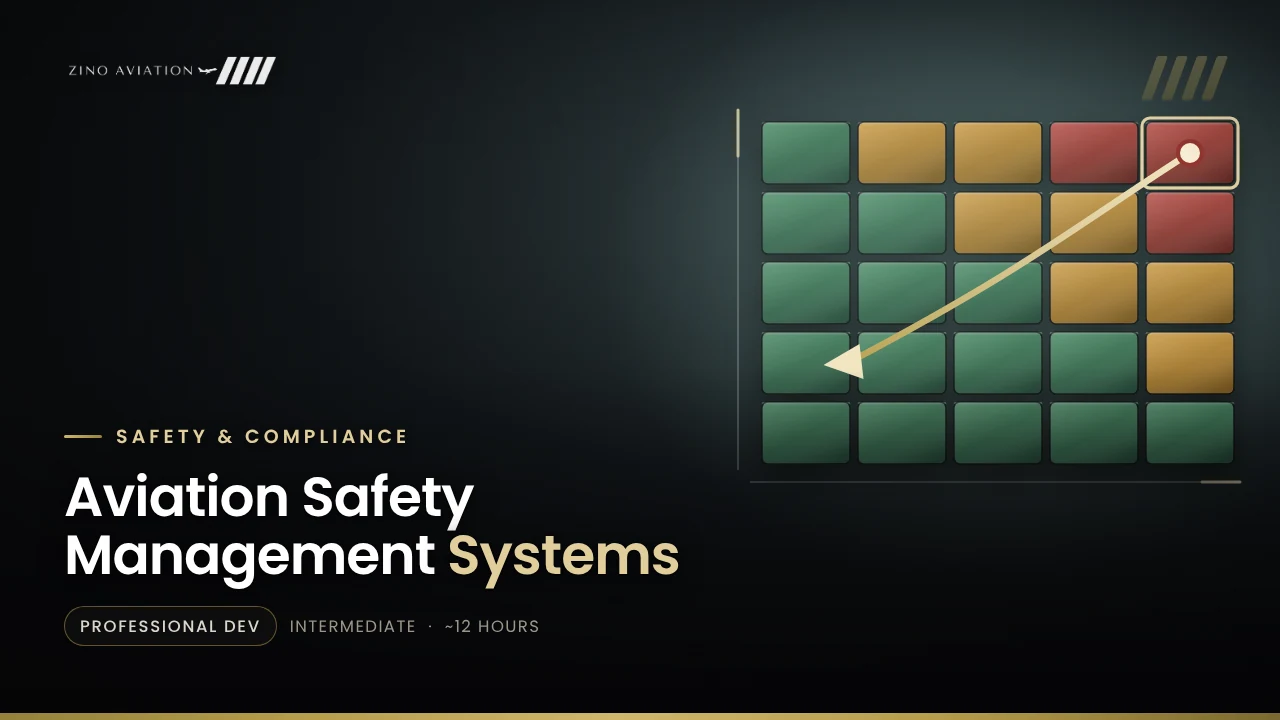
How modern aviation organisations manage safety systematically — hazard identification, risk assessment, safety assurance and building a reporting culture. Structured around the four ICAO SMS components.
Master the core concepts of aviation safety management systems (sms) through guided AI tutoring, worked examples and scenario-based practice.
Syllabus
Course chapters
Chapter 1: Why Safety Management: From Reactive to Predictive
This chapter explains why the industry stopped waiting for accidents and started managing safety as continuous organisational work. It defines safety as aviation uses the term, traces the three eras of safety thinking, introduces the organisational-accident model that underpins modern practice, and positions the Safety Management System as the structure that turns safety from a value statement into managed daily work.
Chapter 2: The International Framework: Annex 19 and the Four Components
This chapter maps the regulatory architecture of safety management: ICAO Annex 19 and the Safety Management Manual, the State Safety Programme each country operates, the service providers required to implement an SMS, and the framework of four components and twelve elements that gives every conforming SMS in the world the same skeleton. It closes with safety performance and why implementation is phased.
Chapter 3: Component 1 — Safety Policy, Accountability and Documentation
The first component creates the conditions every other component depends on: visible management commitment expressed in a safety policy, a named accountable executive, defined accountabilities through the management chain, appointed safety personnel with the independence to do their work, coordinated emergency response planning, and documentation that makes the whole system inspectable.
Chapter 4: Component 2 — Hazard Identification and Safety Risk Management
This is the operational heart of the SMS: finding hazards before they find the operation, assessing the risk of their consequences, and driving that risk to a level the organisation can defend. The chapter covers the sources and methods of hazard identification, the discipline of separating hazards from consequences and risks, probability and severity assessment, tolerability decisions, mitigation, and the documentation that keeps risk decisions honest.
Chapter 5: Component 3 — Safety Assurance: Measuring, Monitoring and Managing Change
Risk management decides what the controls should be; safety assurance proves whether they work. This chapter covers safety performance monitoring and measurement — indicators, targets and triggers, and the data systems behind them — internal audit and evaluation, the management of change, and continuous improvement of the SMS itself. The recurring theme is verification: an SMS that cannot show evidence of performance is a set of intentions.
Chapter 6: Component 4 — Safety Promotion: Training, Competence and Communication
The fourth component supplies the human fuel of the SMS: personnel trained and competent for their safety duties, and communication that moves safety information to the people who need it — in both directions. This chapter covers SMS training by role, competence beyond the classroom, the channels and disciplines of safety communication, and feedback to reporters: the single communication act that most directly sustains the reporting system.
Chapter 7: Safety Culture, Just Culture and Reporting Systems
The SMS processes of the previous chapters run on information volunteered by people — and people volunteer information only inside a culture that makes it safe and worthwhile. This chapter examines safety culture and its components, just culture as the deal that makes honest reporting rational, the behavioural line between acceptable and unacceptable acts, the architecture of reporting systems, and the protection of safety data.
Chapter 8: SMS in Practice: Implementation, Interfaces and the Frontline Professional
The final chapter brings the framework to ground level: how implementation is planned and phased in a real organisation, how the SMS operates across interfaces with contractors and partners, how the four components appear in the daily work of typical aviation roles, what regulators look for when they assess an SMS, and the habits that make an individual professional an asset to any safety system they join.
Each lesson ends with a knowledge check. Every subject finishes with its own final assessment of multiple-choice and scenario-based questions, with full rationales and a 70% pass mark.
All tutoring is grounded in Zino Aviation’s own Aviation Safety Management Systems (SMS) material — the AI tutor won’t invent regulations or figures that aren’t in your source.